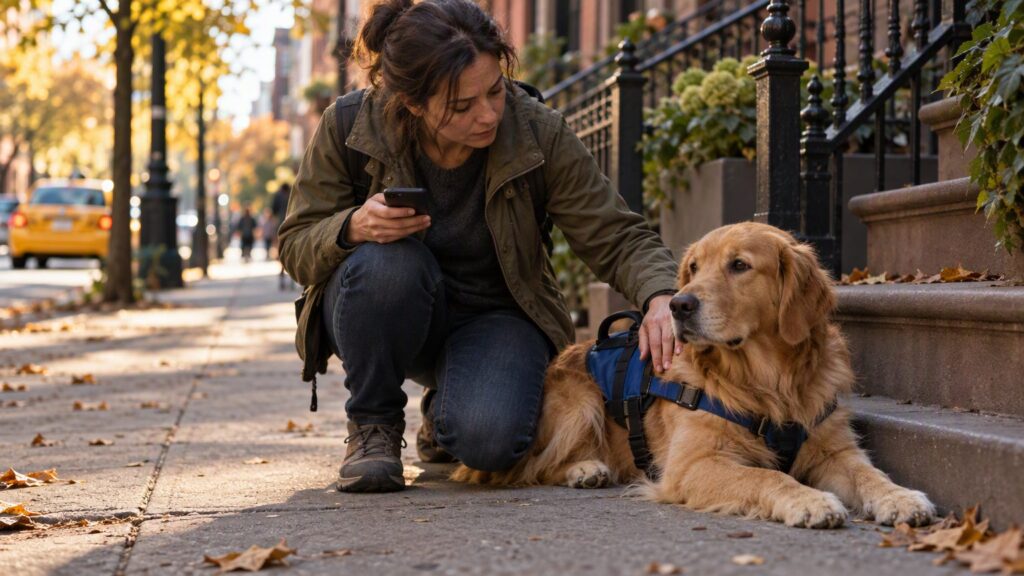
When another dog attacks a service dog on a crowded New York sidewalk, emergency care and time off work may follow. In April 2025, New York’s Court of Appeals restored ordinary negligence claims against dog owners in Flanders v. Goodfellow.
Get yourself and your service dog to safety after an attack in New York without reaching between the dogs. Call 911 if danger continues, and get emergency veterinary care. Photograph the injuries and scene, get the owner’s identity and witness contacts, and report the attack to police. Get medical care for your own injuries too.
What to do when a service dog is attacked by another dog
Give the attacking dog a wide berth. While the threat is active, call 911; even minor-looking wounds need a prompt veterinary evaluation.
- Create distance safely. Keep bare hands out from between fighting dogs; don’t grab near their mouths. Use a solid barrier, such as a closed door, only if doing so won’t bring you near either dog.
- Call for emergency help now. If the owner can’t regain control or the dog is still loose, call 911. When moving isn’t safe, have a bystander call and help you get to shelter.
- Check yourself and your dog for injuries. Check yourself and your dog for bleeding, breathing trouble, collapse, limping, or signs of shock. Fur can hide punctures. Tell responders about your injuries and disability-related assistance needs.
- Obtain veterinary attention. Have the veterinarian assess infection risk while checking for punctures and crushing injuries. Request written restrictions on the dog’s trained work.
- Exchange details. Get contact details along with the owner’s name. Request the dog’s license or rabies information and the address where it is normally kept.

Put safety first; you’re not required to restrain either dog. Follow the veterinarian’s work restrictions, even though an injury doesn’t automatically mean your dog must retire. If your dog can’t perform tasks safely, use your established backup plan where available, such as assistance from a trusted support person.
How to document injuries after a service dog attack
Store receipts and witness contacts alongside photographs and veterinary records. Once safety and treatment permit it, note the details identifying the other dog and its owner.
Care comes before paperwork. Emergency treatment mustn’t wait for documentation. When practical, photograph blood and damaged equipment, including mobility gear, as well as injuries before and during treatment. Record gates or broken fencing and posted leash rules. If photographing the other dog and owner would escalate the confrontation, don’t do it.
| Evidence | What to preserve | Why it may matter |
|---|---|---|
| Veterinary records | Exam notes and diagnoses; treatment plans and invoices | Connects treatment and costs to the attack |
| Photos and video | Wounds and scene conditions; damaged gear | Documents details that may change quickly |
| Witness information | Names and phone numbers; brief accounts | Provides independent evidence of what occurred |
| Service-related records | Training history and work restrictions; retraining evaluations | Shows how the injury affected the dog’s trained work |
Note the exact location along with the time. Explain in chronological order where each dog approached and whether either was leashed, along with any warnings exchanged and what happened immediately afterward. Describe your route to safety and where you went.
Ask building staff promptly to preserve security video. Keep your account factual rather than posting allegations online.
How New York defines and handles a dangerous dog
A dog’s conduct, not its breed, matters under the dangerous-dog definition in New York Agriculture and Markets Law § 108; an unjustified attack causing physical injury falls within it. Behavior also falls under Section 108(24) when a reasonable person considers it a serious and unjustified imminent threat of serious physical injury or death.
The definition expressly covers unjustified attacks that injure or kill service dogs, as well as guide or hearing dogs. Describe specific conduct rather than relying on a breed label. The circumstances matter, including whether the dog was reacting to an attack.
Anyone witnessing an attack or threatened attack may complain to a dog-control officer or police officer under New York Agriculture and Markets Law § 123. An officer’s initial assessment doesn’t decide dangerousness; courts do, through the statutory process. Precautions such as secure confinement or public muzzling may be required if a court finds the dog dangerous.
Say whether the service animal was working when you report a dog that attacks a service dog. Describe the other dog’s actions as you explain the injuries.

But a handler doesn’t have to be bitten for an incident to matter. Report your service dog’s injuries, noting what assistance the attack stopped it from providing. A report also records danger to others using the same sidewalk or building entrance.
Reporting an off-leash attack and tracking the resulting costs
If an uncontrolled dog poses immediate danger in New York City, don’t wait to call 911. Tell police about the attack once you’re safe. Use NYC Health’s animal-bite reporting process for a human bite or possible rabies exposure.
When reporting that “an off-leash dog attacked my service dog,” specify exactly where it happened and which leash rules applied. Record what the owner was doing and any known earlier warnings or complaints. Proving negligence and damages in a claim supported by a leash-rule violation takes more than pointing to that broken rule.
Can veterinary and replacement costs be recovered?
Veterinary bills are expenses you can seek to recover. To recover replacement and retraining costs, you’ll need evidence of those expenses; payment isn’t automatic. The owner or lawful custodian of a legally dangerous dog is strictly liable under Agriculture and Markets Law § 123(10) for qualifying medical costs, including veterinary care, subject to statutory exceptions.
Even without a previous bite, a lack of reasonable care in controlling a dog supports an ordinary negligence claim under the Court of Appeals’ ruling in Flanders v. Goodfellow, 2025 NY Slip Op 02261. Tie your claimed losses to the conduct that caused them, backing up the claim with proof of fault.
Keep medication bills together with the veterinary invoices. Save damaged-equipment receipts and professional retraining assessments, along with written work restrictions. And document what each claimed expense paid for and why the attack made it necessary, especially if you seek replacement costs.
Short answers for handlers and witnesses
Why shouldn’t people pet a working service dog?
Dogs trained for disability-related tasks are covered in ADA.gov’s service-animal guidance. Without the handler’s permission, don’t pet a working dog or call to it, though touch isn’t universally forbidden. Feeding the dog, or distracting it some other way, can interrupt the task it’s trained to do.
What does a Level 3 dog bite look like?
On the Dunbar bite scale, Level 3 generally means one to four punctures from a single bite, none deeper than half the dog’s canine-tooth length. Lacerations can happen as the dog or victim pulls away. This behavior-assessment scale isn’t a medical diagnosis.
When does a person need medical care after a bite?
After a bite, get medical attention as New York public-health advice directs. Seek prompt assessment for deep punctures or wounds to the hand or face. Ask for medical advice too when your tetanus vaccination is overdue or the dog’s rabies status is unknown. Uncontrolled bleeding or loss of function warrants emergency care.
Which symptoms after a bite are warning signs?
Worsening pain needs attention; watch for infection showing up as increasing redness, warmth, swelling, or drainage. Fever or red streaks mean it’s time for prompt medical care. Get urgent veterinary care for your service dog if it collapses or keeps bleeding, shows pale gums, struggles to breathe, or has severe pain.
Can a dog be trusted after it bites?
A bite alone doesn’t tell you whether that dog can be trusted. Ask a veterinarian to check for pain or illness, followed where appropriate by a qualified behavior professional’s assessment of triggers and future risk. Your injured service dog’s return-to-work assessment is separate from the attacking dog’s behavior evaluation.
Protect the record while care comes first
Put off paperwork while you get to safety and receive treatment. Make the appropriate reports when you’re able, keeping a clear record of what happened. While authorities review what the dog reportedly did, your veterinarian can monitor recovery. Keep your expense records with records of work restrictions and follow-up evaluations. Prompt documentation gives insurers and legal advisers concrete facts without treating compensation or a return to work as guaranteed.
Sources
NYC Health: animal-bite and rabies-exposure reporting
Flanders v. Goodfellow, 2025 NY Slip Op 02261; ADA.gov service-animal guidance; Dunbar Dog Bite Scale; New York State Department of Health dog-bite prevention guidance.